

My TP/SL didn't close my position at the exact price I set
My TP/SL didn't close my position at the exact price I set
This is normal behavior. A stop loss works very differently from a limit order.A limit order executes only at the specified price or better.A stop order, on the other hand, is triggered when the mark or last traded price reaches the user’s specified trigger level (this can be customized on Pacifica).During periods of volatility, orderbook prices can move past the trigger level before triggering the stop order. This is especially true when mark price is used.This, along with natural orderbook slippage - which can be higher during periods of volatility - causes discrepancies between TP/SL prices and actual execution.This is expected behavior across all exchanges, and it’s extremely rare for a TP/SL order to execute exactly at the trigger price due to normal market movement and liquidity dynamics.
My TP/SL did not close my position as the price kept moving in a single direction
My TP/SL did not close my position as the price kept moving in a single direction
A stop-limit order works in two stages:When the trigger price is reached, it places a limit order at the specified limit price.That limit order will then attempt to execute at that price or better.However, if the market falls through your limit price and doesn’t recover, the limit order may remain unfilled, creating the impression that the stop-limit didn’t work. In reality, it worked as intended - it just couldn’t execute because the market moved past your limit.To guarantee that your position closes once the trigger is hit, consider using a stop-market order instead of a stop-limit order. Stop-market orders prioritize execution, while stop-limits prioritize price.Especially if using stops to prevent liquidation, we highly recommend using stop market orders to guarantee execution.
My TP/SL was not triggered despite crossing the price level on the chart
My TP/SL was not triggered despite crossing the price level on the chart
This is likely because of the mark price being used to trigger stops. Using mark price to trigger stops has the advantage of having exchange-isolated ‘wicks’ not trigger a user’s orders.If you would like to have TP/SL be triggered using last traded orderbook price, you can change the trigger condition of your stop orders when placing a stop order to “Last traded”.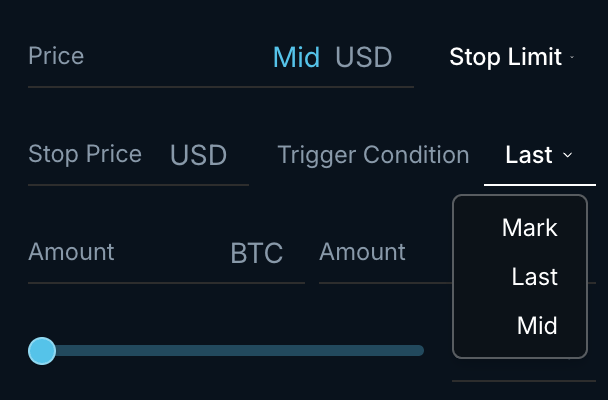
How do TP/SL limit orders work?
How do TP/SL limit orders work?
Stop-Loss and Take-Profit orders are triggered by the mark/last/mid price. Once triggered, a limit order is placed to try to close off your position.Long Positions - Stop-Loss (SL)If you are long and set a trigger price of $25 and a limit price of $25, when the mark price falls below $25 a limit sell order at $25 will be placed. If the market drops quickly from $26 to $23, your order may rest at $25 without filling.If instead you set a limit price of $22, the order has a higher probability of filling somewhere between $23 and $22 during a sharp move. Lower limit prices increase fill probability but may result in worse execution.Long Positions - Take-Profit (TP)If you are long and set a trigger price of $32 and a limit price of $31.50, when the mark price rises above $32 a limit sell order at $31.50 will be placed. This protects you from selling below $31.50 if the price quickly retraces after triggering.Short Positions - Stop-Loss (SL)If you are short and set a trigger price of $30 and a limit price of $30, when the mark price rises above $30 a limit buy order at $30 will be placed. If the market spikes rapidly from $29 to $33, your order may not fill.If instead you set a limit price of $34, the order has a higher probability of filling somewhere between $33 and $34 during fast upward moves. Higher limit prices improve fill probability but may result in worse execution.Short Positions - Take-Profit (TP)If you are short and set a trigger price of $20 and a limit price of $20.50, when the mark price falls below $20 a limit buy order at $20.50 will be placed. This ensures the order will not fill at a worse price (above $20.50) if the market rebounds after triggering.